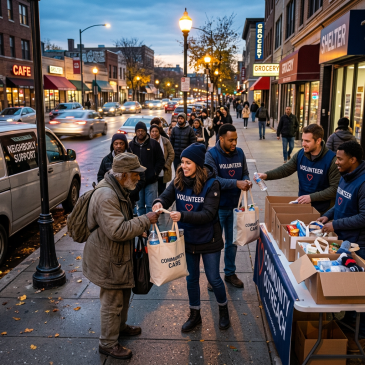
HELP TO FIND A HOME AND COMMUNITY SERVICES BEFORE EVICTION FROM HOMELESS ENCAMPMENTS.

Federal Conservative Leader states: New legislation permitting Police Officers to remove all homeless encampments from public spaces

I am disappointed to hear a leader sharing this information:

On April 23, 2025, CP24 broadcast Mr Poilievre informing attendees at a political forum that when he is the Prime Minister of Canada, he will give police officers the power to remove all homeless encampments across Canada!

Two very important things came to mind:
1. Where will the police officers find the resources and the time to add this role to their duties of maintaining public safety, enforcing the laws and protecting the communities? Would the police services need to hire social workers, mental health workers, find housing and other areas of support that the homeless require?
2. Will he also ensure that police officers (along with all they already do) provide other aspects of healthcare, rehabilitation and job training? Will police officers be assigned to provide food assistance programs, transportation and substance abuse treatments?
I suggest that this leader collaborate with the folks who are on the ground doing this work daily on behalf of our homeless folks along with those who have experienced homelessness to ensure community wide engagement to actively work on barriers and solutions. Allow police officers to do what they are trained to do and to collaborate when required.
I am discouraged by this leader’s lack of knowledge about the homeless who live in encampments. May he increase his knowledge so that if he becomes the next Prime Minister of our country, he ensures that there is a an assigned MP who has compassion and empathy and who is given the resources to collaborate with our provinces , northern territories and municipalities to find solutions to these sad situations. We must all uphold dignity and human rights of everyone. Forced encampment evictions make people more unsafe and expose them to greater risk of harm and violence. They did not purposefully choose this life style.

What homeless folks need the most are those who will make a positive difference in their lives.

Consider ways you can help: Make a donation to the shelters, not necessarily money.

Here are a few ideas: toiletries: toothpaste and toothbrushes, these items bring a smile and basic hygiene care, personal hygiene products, soap and shampoo in plastic bottles, shaving cream and disposable razors, clothing such as underwear, T-shirts, menstrual supplies, infant and toddler supplies, gentle used clothing and toys.

There are other ways that each of us can be kind and helpful. When the homeless are removed from these encampments, support them to move upward and onward. Think of what your needs would be if you became homeless.

Remember: kindness, thoughtfulness, tolerance, gentleness, compassion, and caring.

BLACK FOLKS AND STROKES: (CVA)Prevention:BLACK FOLKS AND STROKES: (CVA)

I thank 100ABCWomen (Accomplished Black Canadian Women) for this opportunity to speak with you about Black folks and strokes.

What can we do to keep healthy?

As Black Canadians, we take pride in our strength to withstand the stressors of everyday life coupled with racism and other forms of oppression; however, pushing through the pain and stress is literally killing us. We think we can do it all. No, we can’t and should not be doing so.

Stroke is the leading cause of death every year in Canada. There are over 50,000 incidents of strokes, and 14,000 of those folks die. There are presently over 300,000 Canadians who are living with disabilities caused by strokes. We do know that large numbers are Black folks, but we do not have exact stats as they do in the US, mostly anecdotes from healthcare reporting.

In the USA, 50% of Blacks have more strokes than their white counterparts. They also have the highest rates of death after strokes. As our population grows in Canada, we will see similar results in the future unless we educate ourselves about preventative measures.

There are many unrelenting causes and effects of strokes in Blacks where racism is the root, leading to many chronic stressors. Also, a few genetic traits, such as high blood pressure, you may know families where every adult has hypertension; combine that with:

o Unmitigated systemic racism causes frequent stressors on your body, which triggers stress-coping behaviours like drinking, smoking, and eating fast food, to mention only a few.

o The inequity of life experiences in socioeconomic areas… good-paying jobs, access to affordable housing and education, and intergenerational stressors and traumas that have not been resolved.

No wonder so many of us, as Black Canadians, have strokes, and many are disabled afterwards.

Prevention:

So, with all these factors, what can we do to keep healthy?

We are told about several lifestyle changes that we must make. I’d like to say the change needs to start in our minds. No matter what we are told about diets, weight loss, managing diabetes and hypertension, if we do not learn to attract more positive ways of living and have an attitude of gratitude that recharges our souls and revitalizes our bodies, we will not be successful in preventing strokes. Reprogram your mind for good health outcomes; we can literally change the pathways of our brains by practicing new and healthy thoughts and behaviours over and over. Be confident and have the right people in your corner, which adds value to your life. Have someone who will say, let’s go for a walk, let’s go to the movie, or even let us go to the Gala. Be sure it is someone who will tell you when you need to move your body.

Social media tells you to take an aspirin if you think that you are having early signs and symptoms of a stroke or heart attack. This approach does not work for everyone as you do not know what kind of stroke you are having, and aspirin is to be used only in the acute stage of an ischemic stroke. (Blockage of an artery which leads to an inadequate amount of blood to the brain)

Aspirin does not help if you have a hemorrhagic stroke (a weakened blood vessel in the brain ruptures).

You do not have time to self-diagnose either type of stroke; it requires emergency management… call 911…

Spotting the signs and symptoms:

Sudden loss of brain function is caused by either a blockage in an artery which takes oxygenated blood to the brain or a bleeding/ rupture in the brain from a weakened blood vessel.

Act FAST:

Facial droop, paralysis in one side of the body/ face

Arm or leg weakness

Speech slurring, unable to understand spoken words, or even speaking unintelligible.

Time must act quickly to seek healthcare for oneself or another person.

The longer the wait for emergency care, the greater the disability

Life is a gift; handle it with care. Be Well!

Norma Nicholson MA(Ed) BA RN (Retired), Author, Youth Advocate, Educator

“What doesn’t kill you may make you weak”: Reflections on Mental health in the Black Community.

Authored by Norma Nicholson and Maame Debrah, Community Outreach Coordinator UWPR

A Very Powerful Old Phrase

We have all heard it before, “What doesn’t kill you makes you stronger” and although this may be true; when it comes to mental illness this may not be the case. For African, Caribbean and Black (ACB) Canadians, the struggle for mental health is often a silent one, said Stacey-Ann Buchanan, an actress presenting her film The Blind Stigma at the Black Health Alliance “Sound Mind” Mental Health forum held on November 14, 2015. Mental illness is truly invisible however it doesn’t make it any less real for those who are affected. In fact, 1 in every 3 Canadians experiences a mental health problem each year.

Mental health or well-being for African Canadians is a balanced and healthy outlook, attitude, behaviour and life practices consistently filled with joy, satisfaction, autonomy, a sense of purpose, a positive orientation, confidence, resilience, self-worth and strongly affirmed racial, cultural and social identity.

While mental health revolves around health promotion and prevention of illness and dysfunction, mental illness refers to impairments in thinking that lead to significant distress and daily problems in living and may include chronic stress, stress-related trauma, and depressive symptoms. The severity of symptoms can range from mild to severe.

An unfolding mental health crisis and a deep crisis of identity grip African Canadians. Research indicates that Blacks access mental health services at a 50% later rate than any other group and this is concerning. However, late access to treatment and support must take into consideration the lack of cultural competence of mainstream mental health agencies, confusion about “Westernized” concepts of mental health and illness, language barriers and racism. Dr. Kwame McKenzie, CEO of the Centre for Addiction and Mental Health (CAMH) speaking at the “Sound Mind” forum noted that the “black population is under attack from racism and neglect”.

Health promotion and prevention of illness

Racism is complex, functions at different levels and has serious cognitive, interpersonal, and environmental effects on individuals. Evidence shows that living in racialized countries can increase a person’s chance of developing anxiety and depression. Mental illness can be induced by direct and vicarious trauma connected with being witnesses and victims of unrelenting state violence, most vivid in police violence and brutality. The Black community’s disproportionate involvement in the criminal justice system and community and interpersonal violence only serve to exacerbate this plight. Furthermore, precarious employment, underemployment and poverty are risk factors for poor mental health.

Blacks are plagued by a crisis of poor community leadership in mental health very minimal holistic client-centred, anti-racist health prevention strategies, and limited community representation in planning and programming. As a result of these barriers many mental illnesses usually go unaddressed for the vast majority of Blacks and often spiral into a whole range of

other serious health problems including death. Culturally rooted stigma associated with mental illness and stereotypes about the “strong” Black woman and “machismo” for black men often prevent people from seeking help when required.

Research with legitimate information

A report “Mapping the Mental Health System in Peel Region”, released by the United Way of Peel Region last year, noting gaps in the system indicates that, emergency departments which are often the first point of contact for patients experiencing mental health challenges have excessive wait times. In addition, most hospitals require referrals to their outpatient programs from general physicians and psychiatrists. For those who do not have access to general physicians, unfriendly policies like these perpetuate the cycle of people ending up in emergency services when they could be receiving community-based support. Navigating the mental health system can be complex and confusing further re-traumatizing individuals who need help.

It is crucial and imperative to provide meaningful ways of averting this crisis. Helping the most vulnerable of the 116,225 Blacks in Peel means we must work proactively to address policy issues related to allocating funds and resources for the first point of contact services to provide the needed support. Improved funding and creative collaborations with mental health organizations, Black communities, and other service providers can allow different stakeholders to play a coordinated role in developing and delivering local mental health promotion and care strategies. Outreach can be expanded to deliver support and services where people naturally congregate and improve access by ensuring cultural and linguistic competence.

Find additional resources in this section

Know someone who is experiencing mental health challenges: A few resources are:

Children: Connect with the school team that includes mental health nurses. Find additional resources at http://www.peelschools.org

Teens and adults: First Episode Assessment Clinic (FACT) Peel. Services 16 – 45. Self-referrals are accepted.

Ask your family doctor to fill out the CAMH referral form and fax it to Access CAMH at (416) 979-6815.

Access a list of programs offered through United Way of Peel’s funded agencies at http://www.unitedwaypeel.org.

Call 211, a telephone helpline that connects people to the right information and services.